TREEALITY
Route: Creative Education
Perception, understanding, relationship, education.
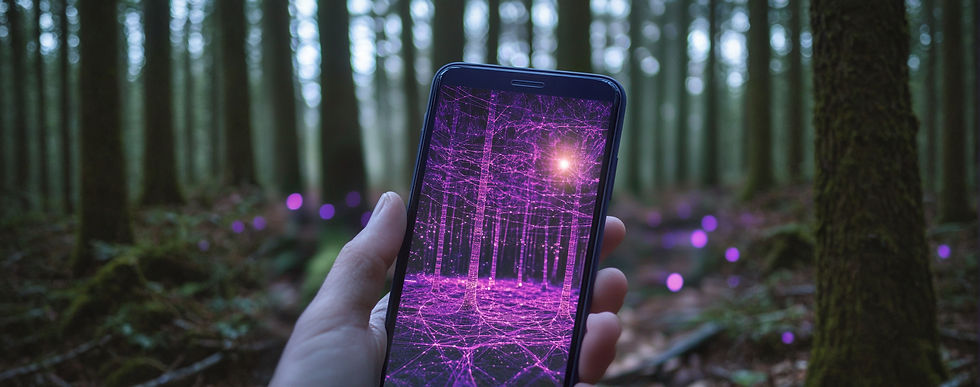
TREEALITY is designed as a transferable AR trail system.
It can be implemented in various forests, parks and urban green spaces – each adapted to the local context of the trees, paths and locations.
The station is not a fixed format, but an open system that can be further developed in new contexts.
Participants experience ecological relationships not through information, but through perception, space, and their own movement.
Central question
How does our relationship with nature change when we no longer perceive forests as a backdrop, but as living systems?
Background
Plant blindness describes the historically ingrained tendency to perceive plants as passive scenery rather than as living organisms.
This perspective dates back to Aristotle, who placed plants at the bottom of the scala naturae, a hierarchy that continues to shape our thinking today.
Because plants move more slowly and respond differently than animals, their capacities often remain invisible and are underestimated.
TREEALITY addresses this by using augmented reality to make plant activity, interconnectedness, and responsiveness visible, creating a new basis for empathy and responsible action.
Our image of plants is shaped by history, not by current scientific knowledge.

Communication & Warning Signals
Trees can:
-
Release chemical warning substances in case of pest infestation,
-
react via air (volatile organic compounds) and soil,
-
They increase their defense mechanisms when neighboring plants are affected.
-
These signals measurably alter the growth, defense substances, and survival chances of neighboring plants.
An evolutionarily developed cooperative system that increases the stability of the entire ecosystem.
Networks:
Wood Wide Web
Trees are connected to one another through mycorrhizal fungi.
This network:
-
distributes resources more efficiently
-
helps buffer stress (such as drought or pest infestation)
-
increases the resilience of forests
Forests do not function as a collection of individual trees, but as a system – an emergent interplay between fungi and plants.
Mother trees & seedlings
-
Older, large trees (“mother trees”) are central nodes within forest ecosystems.
-
They support young plants (seedlings) through underground fungal networks known as mycorrhizae.
-
Among other functions, these networks are used to transfer:
carbon
water
nutrients
chemical signals
This role is dynamic and depends on factors such as location, age, and network density.
Decisions & Intelligence
Trees make decisions.
They prioritize growth, defense, or resource sharing depending on their environment. Roots "choose" nutrient-rich zones, leaves regulate energy consumption, and networks distribute resources in a targeted manner.
This intelligence is decentralized, slow, and collectively organized. Not individual – but systemic.
Intelligence as a process, not as an organ.
Trees can learn.
The life of trees
Why trees are often perceived as "lifeless":
-
Their movements are slow,
-
their processes are not directly visible,
-
Our perception is scaled to animal and human time.
Actually:
-
Trees constantly react to:
-
Light,
-
Water,
-
Temperature,
-
Neighbors,
-
Injuries.
-
-
Growth, defense, cooperation = active life processes.
What we know today


Goals
-
To make nature tangible not as a backdrop, but as a living system
-
Translating abstract knowledge (e.g., ecosystems, interconnections, timescales) into physical experience
-
Promote attention, empathy, and a long-term relationship with the environment
-
Enabling education outside of traditional learning environments
Compass
StudioBOXQ
StudioBOXQ works at the intersection of design, education, and perception.
At TREEALITY, knowledge is not simplified or explained, but translated – into spaces, images and experiences.
The design follows three principles:
-
Experience instead of explain.
Content is not conveyed, but rather made tangible. -
Space as a learning medium
Landscape, path and surroundings are part of the education – not just the means of transportation. -
Technology as a tool, not as a focus
Augmented Reality serves perception, not staging.
Level of impact
TREEALITY does not change behavior, but perception – as a basis for long-term decisions in dealing with living systems.
Project format
-
Augmented Reality Trail in public space
-
site-specific (forest, park, urban green space, educational areas)
-
accessible, self-guided or moderated
-
modularly expandable
TREEALITY is deliberately designed to work in both natural forest contexts and urban spaces – always adapted to the respective tree and environment structure.


